
| Home | Current show | Show archives | Japanese pottery | Tea bowls | Sumi-e | Wabi sabi |
|
Touching Stone Gallery Oriental Sumi-e 墨繪 Ink Painting 水墨畫 |
|
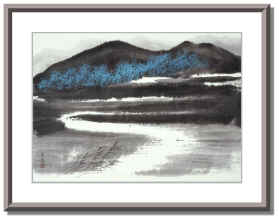
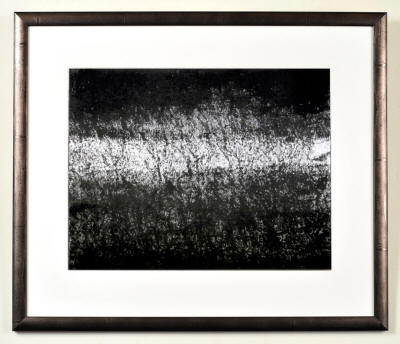 Hiroki Murata Afterimage No.2 |
Touching Stone Gallery is honored to be the only gallery in Santa Fe specializing in sumi-e, a unique Asian art form that captures the essence rather than appearance of the subject. Our gallery hosts regular exhibitions for contemporary sumi-e artists pursuing distinctive styles of sumi-e and ink painting. We sponsor workshops and events to promote cross-cultural artistic interactions through the Santa Fe-Japan Art & Culture Exchange Program.
|
|
Sumi-e, Notan and Modern Art 1 In an old Chinese legend, an artist named Zhang Seng You 張僧繇 was asked to paint a mural in a temple. He painted several dragons but left out the pupils from their eyes. The Abbot asked him why. Zhang explained that if he painted the pupils, the dragons would come alive. When the Abbot insisted, Zhang proceeded to paint the dragons’ eyes. As soon as he finished the pupils on one of the dragons, it roared to life and flew away in a thunderous flash of lightning! This story embodies the philosophy of Oriental sumi-e. The goal is not simply to reproduce the appearance of the subject, but to capture its soul. To paint a horse, the sumi-e artist must understand its temperament better than its muscles and bones. To paint a flower, there is no need to perfectly match its petals and colors, but it is essential to convey its liveliness and fragrance. Oriental sumi-e may be regarded as an earliest form of impressionistic art that captures the unseen. Indeed, Oriental sumi-e has long inspired modern artists in the West. In his classic book Composition, American artist and educator Arthur Wesley Dow (1857–1922) wrote this about sumi-e: "The painter ...put upon the paper the fewest possible lines and tones; just enough to cause form, texture and effect to be felt. Every brush-touch must be full-charged with meaning, and useless detail eliminated. Put together all the good points in such a method, and you have the qualities of the highest art"2. Dow’s fascination with sumi-e not only shaped his own approach to art but also helped free many American modernists of the era, including his student Georgia O’Keeffe, from what he called a 'story-telling' approach. Dow strived for harmonic compositions through three elements: line, notan, and color. He advocated practicing with Oriental brushes and ink to develop aesthetic acuity with line and notan. Notably, the term notan (often translated simplistically as dark-and-light) was derived from two characters originally used in Chinese and Japanese sumi-e: no 濃 (dense) and tan 淡 (dilute). Together, no-tan refers to the varying ink density produced by grinding an ink stick in water. Sumi-e artists spend years practicing basic brush strokes to refine their brush movement and ink flow. In the hand of a master, a single stroke can produce astonishing variations in tonality, from deep black to silvery gray. Thus, in its original context, notan means more than just dark-light arrangement, it is the basis for the beautiful nuance in tonality unique to Oriental sumi-e and brush-and-ink calligraphy. This ancient aesthetic concept of tonal balance has found powerful applications in contemporary Western painting and other disciplines from photography to graphic design.
1. From an original article by Tim Wong, Ph.D. and Akiko Hirano, Ph.D., written for the 2001 American debut of Wang Nong's sumi-e exhibition in Touching Stone Gallery, Santa Fe. 2. Arthur W. Dow. Composition. The County Life Press. Garden City. New York. 1913
Copyright © Touching Stone Gallery. All rights to texts and images reserved |
|
|
Click on images to see featured artists' shows |
|
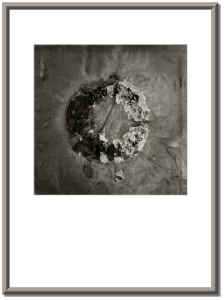 |
Susan Christie Susan Christie's unique style evolved from extensive disciplined classical Oriental sumi-e training combined with the freedom and expressiveness of contemporary American painting. |
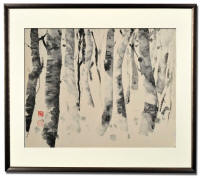 |
Fumiko Kurokawa Fumiko Kurokawa, a Japanese sumi-e artist focusing on landscape and still life, captures the quintessential of tranquil country life in rural Japan in her paintings. |
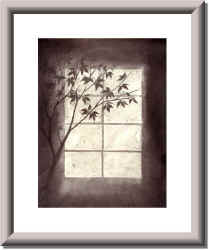 |
Hiroki Murata Hiroki Murata explores unique visions with novel applications of sumi ink that push the boundary of the medium. |
 |
Wang
Nong One of the foremost contemporary Chinese sumi-e artists of this generation, Wang Nong is noted for his spectacular landscapes that merge power with sensitivity. |
Photography and web design by Touching Stone Images. All texts and images protected by US and international copyright laws.
Copyright © Touching Stone. All Rights Reserved.