
| Home | Current show | Show archives | Japanese pottery | Tea bowls | Sumi-e | Wabi sabi |
|
侘 寂 Wabi Sabi - Learning to See the Invisible Tim Wong, Ph.D. & Akiko Hirano, Ph.D. Read original article from Touchingstone.net |
|
"Defining wabi sabi in physical terms is like explaining the taste of a piece of chocolate by its shape and color." - Wong & Hirano |
|
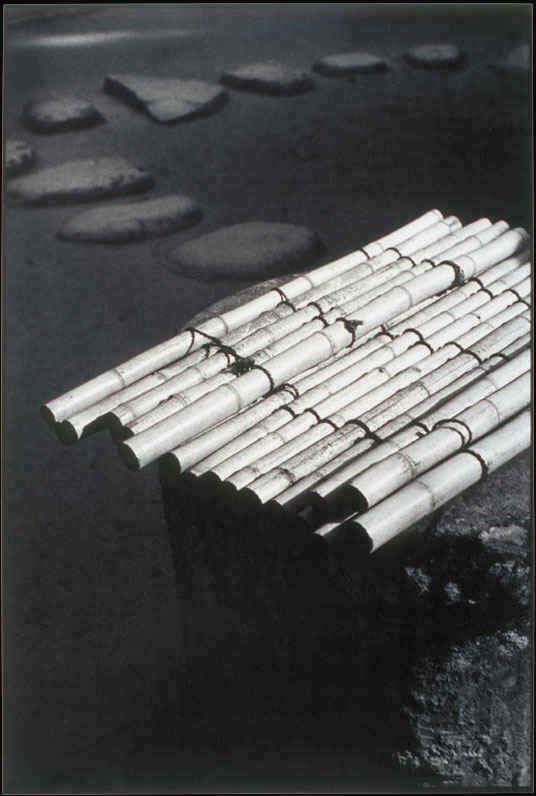 Tsukubai silver-gelatin print ©Tim Wong |
What is wabi sabi? Ask a Japanese
this question and there will likely be a long silence. Pose
the same question to an American, however, the answer will
often be quick and sure: "It’s beauty of things imperfect!"
Why do the Japanese struggle for an answer to the meaning of
wabi sabi that seems to come easily to Westerners? Could
they be searching for a different answer altogether? "Translation," wrote Kakuzo Okakura, author of the classic The Book of Tea, "can at best be only the reverse side of a brocade, - all the threads are there, but not the subtlety of color or design." Few examples illustrate this better than the Japanese concept of wabi sabi. Westerners tend to associate wabi sabi with physical characteristics - imperfection, crudeness, an aged and weathered look, etc. Although wabi sabi may encompass these qualities, these characteristics are neither sufficient nor adequate to convey the essence of the concept. Wabi sabi is not rigidly attached to a list of physical traits. Rather, it is a profound aesthetic consciousness that transcends appearance. It can be felt but rarely verbalized, much less defined. Defining wabi sabi in physical terms is like explaining the taste of a piece of chocolate by its shape and color to someone who has never tasted it. As long as one focuses on the physical, one is doomed to see only the back side of the brocade, while its real beauty remains hidden. In order to see its true essence, one must look beyond the apparent, one must look within. The term wabi sabi consists of two kanji 漢字 (Chinese characters) shared by Japanese and Chinese. Originally, wabi 侘 means ‘despondence’, and sabi 寂 means ‘loneliness' or 'solitude'. These are words for feelings, not for physical appearance of objects. The term embodies a refined aesthetic sensibility that was very evident in ancient Chinese art and literature long before the concept was popularized in Japan through the introduction of Zen Buddhism, literature, and the Tea Ceremony. Asians are not born with this aesthetic sensibility. They develop it through long exposure to classical literature, brush painting, and especially to poetry. Consider this famous poem by the eighth-century Chinese poet Cheung Chi (張繼) : |
| 月落烏啼霜滿天 江楓漁火對愁眠 姑蘇城外寒山寺 夜半鐘聲到客船
Moon setting, a crow caws,
the sky filled with frost
Maples by the river,
fishermen's lights, the traveler facing a sad sleep
Outside City of Suchow, from
the Cold Mountain Temple
Sound of the midnight bell
reaches the traveler's boat
|
|
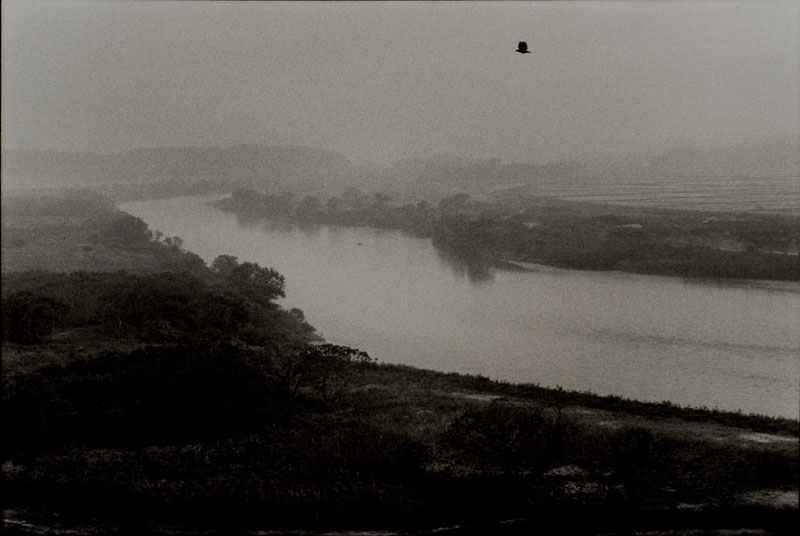 A Crow's Caw silver-gelatin print ©Tim Wong |
|
|
The imagery of this bleak melancholic landscape seen by
the traveler spending a lonely night on the river is
also calm and tranquil. A similar atmosphere is written
into the following haiku by the eighteenth-century
Japanese poet Yosano Buson (与謝蕪村) :
|
|
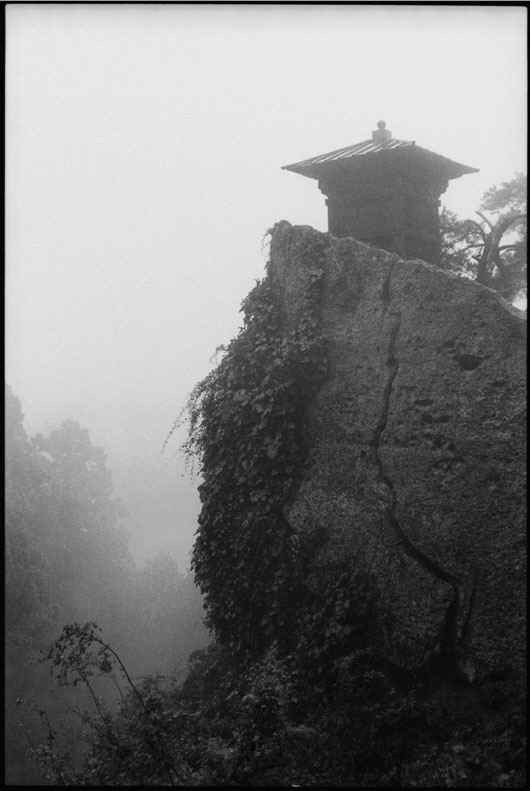 Mystic silver-gelatin print ©Tim Wong |
山寺や
撞きそこなひの 鐘霞む From a Mountain Temple the sound of a bell struck fumblingly vanishes in the mist |
| Poems like these evoke a deeply
personal aesthetic consciousness, a bittersweet mix of
loneliness and serenity, a sense of dejection buoyed by
freedom from material hindrance. This is what wabi sabi
feels like. And one can only experience it by turning the
focus from outer appearance to look within. No wonder the
Japanese struggle to explain wabi sabi; they try to tell how
it feels, not just how it looks! Of course, this aesthetic consciousness is not reserved for Asians. One only needs to look at Walker Evan’s photographs of the interior of an Alabama farm house, or Andre Kertesz’s images of shadows cast by empty chairs, or the central courtyard in Georgia O’keeffe’s home in Abiquiu to recognize a similar aesthetic awareness. These artists speak to the audience through mutual understanding of their private emotions. Such a connection cannot be faked. A common fallacy is to believe an artist can artificially create a resonance with the audience with certain visual cues. Unless the work is a genuine expression of the artist’s feeling, the effect will only appear hollow to the perceptive eyes. Wabi sabi is not a style defined by superficial appearance. It is an aesthetic ideal, a quiet and sensitive state of mind, attainable by learning to see the invisible, paring away what is unnecessary, and knowing where to stop. |
|
|
This article was originally
published in THE Magazine in September, 2007. Copyright ©
Touching Stone Gallery. All rights to texts and images
reserved. Original article from Touchingstone.net |
|
Photography and web design by Touching Stone Images. All texts and images protected by US and international copyright laws.
Copyright © Touching Stone. All Rights Reserved.